
Your course-platform decision is not really about how many tools arrive in a bundle. It is whether one purchase covers lessons, assessments, payments, memberships and learner management without forcing a second system and a migration project.
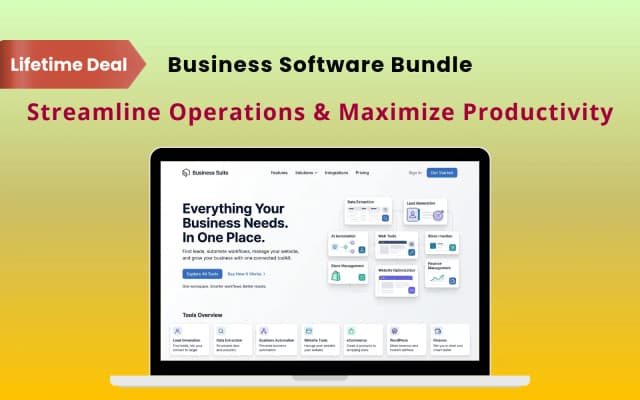
The evidence gives a blunt answer. Academy LMS documents those jobs inside one WordPress plugin. The 7 In 1 Business Software Bundle says seven business software tools are packaged together, but its listing does not name the seven applications or describe their individual features.
Course-platform functionality is therefore absent from the bundle's verified component list. That is not proof that no included tool could teach a course. It does mean the listing gives you no basis for replacing a dedicated LMS with the bundle.
The documented course job
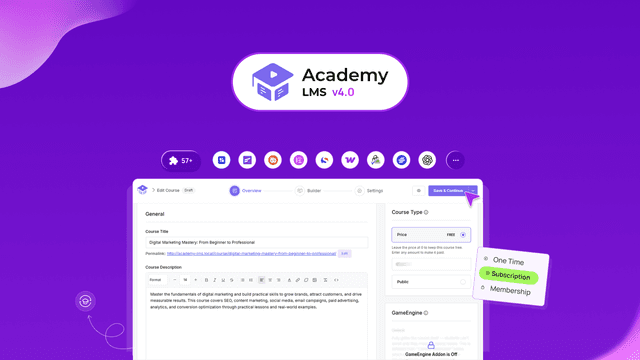
Academy LMS puts courses, quizzes, certificates, payments, memberships and community in one plugin. Its page also lists AI-assisted course creation, YouTube import, chapters, assignments, content drip, prerequisites, SCORM packages and multimedia attachments.
Assessment tools include a dynamic question bank, randomized questions, chapter and final exams, and assignment grading. The learner experience adds certificates, points, badges, personalized nudges, progress tracking, questions and answers, lesson notes, announcements and email notifications.
Commerce is covered too. Payments run through StoreEngine, WooCommerce or SureCart, while course packaging supports bundles, memberships and subscriptions. The page also names bulk enrollment by CSV, custom registration forms, detailed analytics, multi-instructor roles, revenue sharing, team-training seats and device login restrictions.
That is a specific operating checklist, not a bundle-sized promise. For the bundle, the page's own breakdown stops at three headings: Bundle Structure, Operations and Productivity. Bundle Structure means seven business software tools packaged together. Operations means operational support. Productivity means productivity support.
No application names, course features, learner tools or LMS migration details appear. Nothing in the captured listing confirms a course builder, quiz engine, certificate workflow or learner community. That missing course job is the decisive gap.
For this decision, the required jobs are delivering lessons, assessing completion, issuing proof of completion, collecting payment, controlling access and supporting interaction after purchase. Academy LMS puts those named jobs in one plugin. The bundle names business operations, productivity and subscription consolidation, so none of those course jobs can be assigned to a named included application from the available evidence.
Price is clear; the value calculation is not
Academy LMS is listed at $59 and 7 In 1 Business Software Bundle at $129.
For Academy LMS, the listed price is $59, the payment basis shown is one-time, and the access wording is “Lifetime deal.” The price excludes tax, and its entry tier covers one site license.
For the bundle, the listed price is $129, the payment basis shown is also one-time, and the access wording is “Lifetime.” The price excludes tax, and the page lists no extra fee or renewal amount.
A simple calculation shows the gap: $129 minus $59 equals $70, so the bundle costs $70 more. That sounds affordable only if an included application does a job you would otherwise buy separately. The listing does not disclose enough to perform that test.
Total cost needs both the purchase price and the running cost. Academy LMS has the listed purchase price, plus the cost of running the WordPress site that hosts it; its page explicitly puts hosting, updates and plugin-conflict maintenance on the owner.
The bundle listing lists no additional fees, recurring charges or other plan prices, but it gives no component pricing, activation steps, compatibility details or upgrade terms. Thus, $129 is the bundle's documented outlay, while $59 is Academy LMS's entry outlay plus an open-ended running cost. Comparing them as complete course-platform totals would be false precision.
At the same $129 amount, Academy LMS's listed Tier 2 covers 25 site licenses. The bundle's $129 listing provides no site-license count. That is not feature-equivalent, since the bundle contents are unknown, but it removes any simple price-per-site case for the bundle.
Limits, migration, support and updates
Account limits are where the two pages differ sharply. Academy LMS Tier 1 covers one site license. Tier 2 covers 25 site licenses at $129, Tier 3 covers 100 at $249 and Tier 4 covers 200 at $349, according to the live product details.
These are site licenses, not a published learner ceiling; the page describes multi-instructor support, course manager roles, revenue sharing, team-training seats and login restrictions without giving a learner count for the entry tier. The bundle supplies no usage limits. It also gives no account, administrator or learner cap, so you cannot compare capacity on the available facts.
For migration work, Academy LMS says lessons and quizzes can be imported and exported. It also lists YouTube import and SCORM packages as content routes, plus CSV-based learner enrollment. The page does not say those exports include certificates, payments or memberships, so treat those records as separate setup work. The bundle gives no supported content formats, import path, data export, migration tool or handoff process. So replacing a course platform with the bundle has no documented migration route.
Support details cannot rescue the comparison because the available listings do not state enough to make a reliable promise. For Academy LMS, the page makes ownership part of the bargain. You maintain hosting, apply updates and handle plugin conflicts.
The bundle listing supplies no customer-support channel, service expectation, compatibility statement or upgrade path. It also omits redemption, activation and account-setup instructions, which matters before comparing the purchase with a ready-to-run course plugin. Keep the distinction sharp: Academy LMS tells you who maintains the software, while the bundle listing does not identify an update owner for its included applications. That is an operational gap, not proof of poor support. It simply means the purchase terms cannot be verified from the listing.
What would change the decision
The bundle could replace Academy LMS for course delivery if its undisclosed components include a tool that performs the full course workflow. Before treating it as an LMS substitute, get written answers about application names, course-building capability, quiz and assessment handling, certificates, payments, memberships, learner accounts and community tools.
Also check admin and learner limits, content import and export, storage, migration assistance, customer support, update delivery, compatibility and activation steps. Those answers would change a shopping decision; the product label alone cannot.
Require the bundle vendor to map the course workflow to named applications and disclose the relevant limits and terms. Only then compare the $129 bundle price against the Academy LMS tier you need.
Ask whether an included application handles the complete course lifecycle, whether existing courses and learner records can move, what the account caps are, and whether lifetime access attaches to each application or only to the bundle listing. The live page does not answer those questions. That is the core finding.
On the available evidence, Academy LMS covers the documented course-platform job, while the bundle does not document it. Its WordPress ownership requirement is the trade-off. The bundle cannot be counted as an LMS substitute until its components are named and its course, migration, account and support terms are verifiable.
Paying more for “seven tools” does not buy documented course functionality. In this listed-price comparison, Academy LMS costs $70 less and provides the course-specific evidence the bundle lacks. That settles the narrow replacement question, without pretending either lifetime label settles the whole buying decision. Keep both purchase pages together in the full LTD software directory while you check the missing details.