
You didn't start a company to write email subject lines. Yet here you are at 11pm, staring at a half-built sales page, wondering why the words that felt obvious in your head turn to sludge the second you type them. So you do the 2026 thing. You open a tab, sign up for an AI copywriter, paste in your product description, and ask for headlines. Ten seconds later you have five. Three are generic. One is factually wrong. One is almost usable, if you rewrite half of it.
That gap between "almost usable" and "shippable" is the entire story with AI copywriting tools. They are genuinely good at some jobs and quietly awful at others. The cost of not knowing which is which is a website that reads like every other website in your category.
Here's the take that earns me disagreement. AI copywriting tools are time-savers for founders who already know what good copy looks like. For everyone else, they mostly manufacture confidence in mediocre output. The software doesn't hand you taste. It just makes it faster to produce a pile of words you can't yet judge.
What these tools are actually good at
Volume and momentum. If your problem is the blank page, they solve it instantly. Give one a rough paragraph about your product and ask for ten subject-line variations, and you'll have them before your coffee cools. Writing ten decent ones by hand takes most people the better part of an hour.
They're strong at the boring, necessary work nobody wants to do manually: forty product descriptions for an e-commerce catalog, meta descriptions for every page on your site, three tone variations of the same landing-page hero so you can test which one your audience responds to. Feed them a proven framework like PAS (problem, agitate, solve) or AIDA and they'll fill in the structure competently. For a founder shipping a lot of short copy on a tight week, that's real time back.
Repurposing is another honest win. Paste in a rough blog post and ask for five social posts, a plain-text email, and a meta description, and you get a week of distribution from a single asset in about two minutes. None of this requires the tool to be brilliant. It requires the tool to be fast and tireless, which every one of them is.
Where they fall down
They don't know your customer, and they can't. An AI model regresses toward the average of everything it has read, which means it reaches for the sentence a thousand other companies already wrote. Ask for a value proposition and you'll get "streamline your workflow and save time." Technically English. Completely dead.
Worse, they invent specifics with total confidence. A model will happily write "trusted by thousands of businesses" when you have forty customers, or attribute a feature to your product that you never built. That isn't a bug you can prompt away. It's the nature of a system optimized to sound plausible rather than to be true, so every number and claim it produces needs checking against reality before it goes near a customer.
There's a subtler failure too. Good copy makes an argument. It names a problem the reader actually feels, shows why the obvious fix falls short, and positions your product as the sensible next move. Models are weak at arguments because an argument needs a point of view, and the model's only point of view is the statistical center of its training data. It can imitate the shape of persuasion without any of the conviction that makes persuasion work.
There's a compounding problem worth naming. Your competitors are feeding the same tools the same lazy prompts, so the entire category converges on the same phrasing. When four scheduling apps all promise to "streamline your booking workflow," the words stop carrying any signal, and the buyer's eyes slide right past all four. Sameness is expensive precisely because it's invisible on your own screen; your page looks polished in isolation and forgettable in a tab full of rivals.
This is where the confidence trap closes. A founder who can't yet tell good copy from filler reads the fluent output, feels relief, and ships it. The page looks professional. It converts like wet cardboard, and the founder never connects the two, because the writing "seemed fine." Fine is the problem. Fine is what everyone else already sounds like.
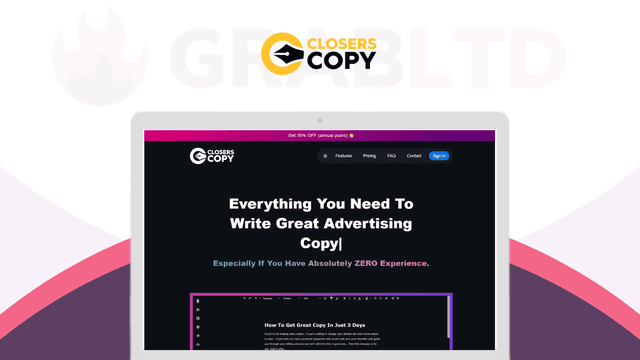
ClosersCopy: built for sales copy, not blog filler
Most AI writers are tuned for blog and SEO content. ClosersCopy is one of the few that built its identity around sales copy, with framework libraries for long-form sales letters, emails, and short-form ads rather than 1,500-word listicles. If your bottleneck is a sales page or an email sequence, a copy-first tool fits the job better than a general content generator does.
It's sold as a lifetime deal at roughly $297 one-time. Set that against a subscription copywriter like Jasper, which runs about $49 a month on its entry creator plan, and the one-time price pays for itself in around six months of equivalent use. If you'd genuinely reach for a copy tool every month, the math favors owning it.
The honest caveat: the interface shows its age, and the raw output isn't as fluent as the newest general-purpose models. You're buying frameworks and a one-time price, not the sharpest sentence generator on the market. For a founder who wants a repeatable skeleton to write against, that trade is often worth making. Expecting polished, paste-ready copy? Look elsewhere, though nothing else in this category truly delivers it either.
The cheaper, lighter options
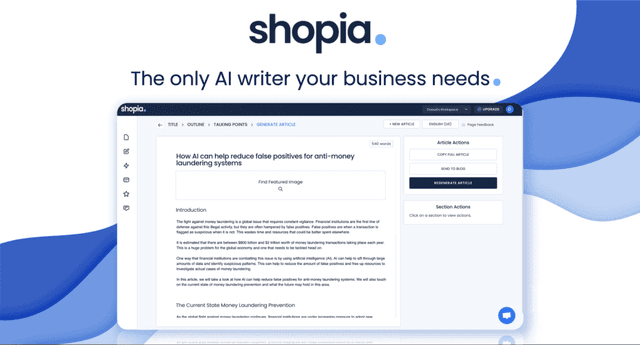
If $297 is more than you want to commit before you know you'll use it, the lighter end of the category deserves a look. Shopia AI Writer and TXTRO both sit closer to the volume-and-drafts job than the sales-page job, and both are available as one-time deals well under a hundred dollars. They're built for producing a lot of short copy and web content quickly without a recurring bill.
Treat their output as a starting point rather than a finished page, especially for anything meant to sell. Their strength is bulk; the editing is still your job. Before committing to any of them, browse the rest of the AI tools directory, because this is the most volatile category on any deal site. Vendors here stack on top of models they don't own, pricing and quality shift under them, and the right tool for you depends entirely on whether you're writing sales pages or churning out product descriptions at scale.
Using one without sounding like everyone else
The founders who get real value from these tools all do roughly the same thing. They feed the model truth instead of adjectives. Instead of "write a headline for my project management app," they give it the actual objection a customer emailed last week, the real before-and-after number, the one specific thing their product does that competitors don't. Specifics are the single input the model can't fabricate, and they happen to be the only thing that sells.
A quick example of the difference. Ask a model to describe a scheduling tool cold and it hands you "save time and stay organized with our easy-to-use platform." Now give it the real detail: your tool cut one client's booking no-shows from 22% to under 6% by firing a confirmation the night before. The rewrite almost writes itself, and no competitor can lift it, because it happened to you. That's the whole game. The model supplies fluency; you supply the one fact that makes fluency worth reading.
Then they ask the tool for structure, not voice. Let it lay out the argument, then rewrite every line in words a human would actually say. Read the result aloud; if you'd never speak the sentence, cut it. Expect to throw away more than half of any first draft, and keep a running file of the best lines you've written yourself, so you're training your own taste rather than outsourcing it. One trick beats most prompt tricks: paste two or three paragraphs you wrote and liked, and tell the model to match that rhythm. It won't nail your voice, but it drifts closer to you and further from the default corporate register.
The tool is a fast intern who has read everything and understood little. Useful for typing. Dangerous the moment you trust it with judgment. If you can't tell whether a headline is good, the software won't tell you either, so learn what good looks like first. After that, let it do the typing.