

AI Tools · Lifetime deal
Claritrix
Weighted scorecards with 18 templates for comparing options and defending decisions.
Claritrix at a glance
- Platform
- Web
- Upgrades
- Lifetime updates are listed.
- Support
- Support is by email.
- Updates
- Lifetime
Our take
Is Claritrix worth buying?
Based on the DealMirror listing, Claritrix is a simple single tier tool for weighted decision scoring with 18 templates. It is light on stated limits and detail, so check whether team scoring fits your group size. It suits recurring choices where you need to show your reasoning.
Good fit if
- You compare vendors, candidates or projects regularly.
- You need to show the reasoning behind a choice.
- You want shared scoring for a small team.
Skip it if
- You want a tool that picks the winner for you.
- You need full project management.
- You need documented team size limits first.
Which Claritrix plan do you need?
Prices in USD, excluding tax.
| Lifetime deal | |
|---|---|
| One-time price | $39 |
| Regular price (DealMirror) | |
| You save | $40 |
| Templates | All 18 |
| Exports | All exports |
| Updates | Lifetime |
| Usage caps | None stated |
Before you buy: DealMirror's terms and extra costs
- Refund. DealMirror lists 30 days for regular buyers and 60 days for DealMirror Prime members.
- Redeem. Redeem your code within 60 days of purchase.
- Upgrades. Lifetime updates are listed.
- Support. Support is by email.
- Platform. Runs in the browser on any device.
What is Claritrix?
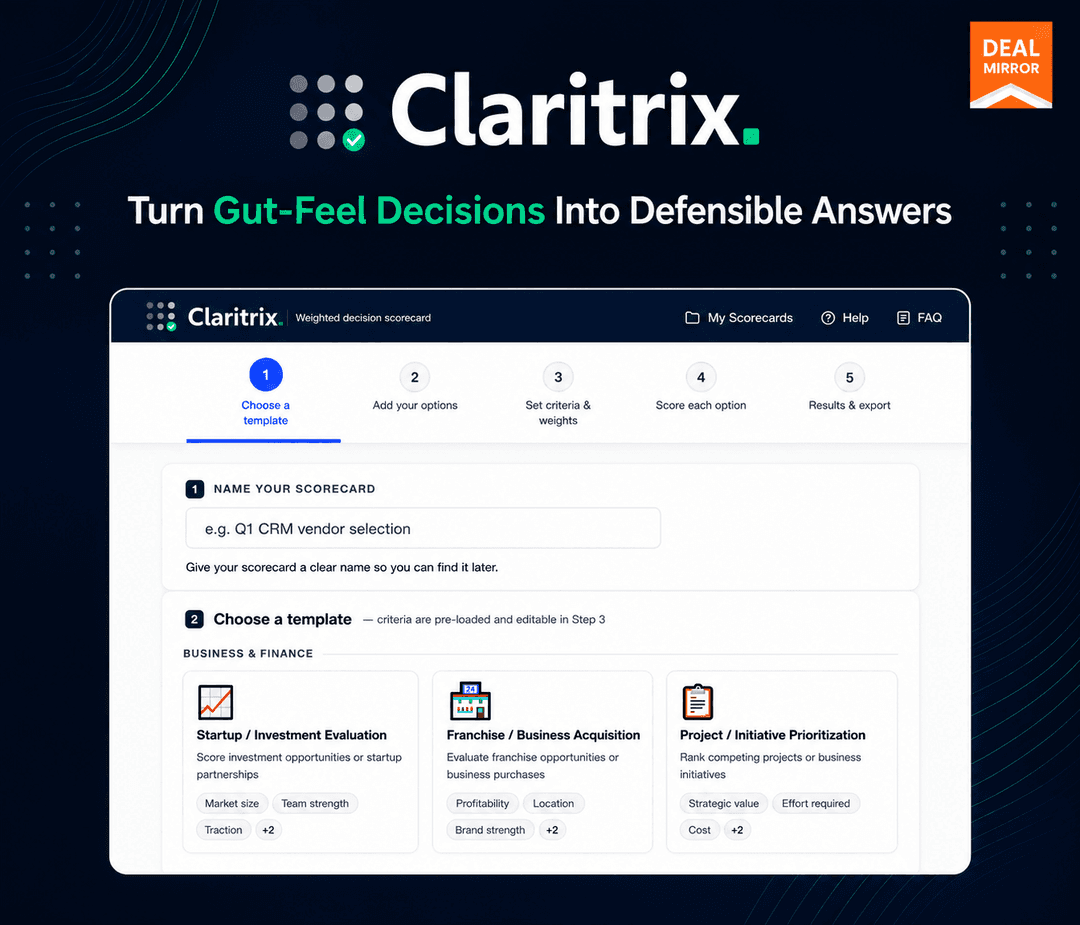
Claritrix is a weighted scorecard tool for making decisions. You list your options, set the criteria and give each one a weight, then score every option and compare results side by side. It includes 18 templates for hiring, investments, vendor selection and project prioritization, plus exports for sharing the reasoning. The deal is a single lifetime tier.
What Claritrix says it does
- 18 ready made templates (Claritrix's figure)
- Weighted criteria with side by side option comparison
- Team scoring in one shared framework
- Export and sharing of results
Why Claritrix
Group decisions often come down to whoever argues hardest. A weighted scorecard makes the criteria and their importance explicit. It structures judgment but does not replace it, because the result depends on the weights and scores you enter.
How does Claritrix work?
Redeem your code
Buy on DealMirror and redeem the code within 60 days.
Pick a template
Start from one of 18 templates or build your own criteria.
Weight the criteria
Give each criterion an importance.
Score the options
Score every option, alone or with your team.
Share results
Export the comparison and the reasoning.
Then it handles:
- Weighted decision scorecards
- Hiring shortlists
- Vendor selection
- Investment comparisons
- Project prioritization
- Team scoring and shared reports
Who is Claritrix for?
Built for
- Managers making hiring or vendor decisions
- Teams that need a defensible way to rank options
- Consultants who present decision logic to clients
Not for
- People who want a tool that recommends options for them
- Teams that need project management beyond scoring
What is included in Claritrix?
Scoring
- Weighted scorecards
- Custom criteria
- Side by side comparison
Templates
- 18 templates hiring, investments, vendors, projects
- Custom templates build your own criteria
Collaboration
- Team collaboration
- Exports all formats listed
- Shareable reports
Video review
We have not reviewed Claritrix on video yet.
Get notifiedBuyer reviews
No reviews yet. Bought Claritrix? Add it to your workspace and share what it replaced.
Add to your workspaceClaritrix questions
What is Claritrix?
A weighted scorecard tool for comparing options against criteria you weight yourself.
How many templates are included?
The page lists 18 templates for hiring, investments, vendor selection and project prioritization.
Can a team score together?
The page lists team collaboration. The number of people allowed is not stated.
Are there usage limits?
The page gives no usage caps. The single tier lists all templates, all exports and lifetime updates.
Does it decide for me?
No. It shows how options compare on the weights and scores you enter.
What is the refund policy?
DealMirror lists 30 days, or 60 days for DealMirror Prime members. Redeem within 60 days.
Often compared with
These are other tools in the same space, not deals on GrabLTD.
- Airtable
- Notion
- Miro
- Decision Matrix Analysis templates
- Trello
Sources
Checked . Prices and terms on this page come from: