

AI Tools · Lifetime deal
Decloak
Find hidden website risks and prioritize security fixes
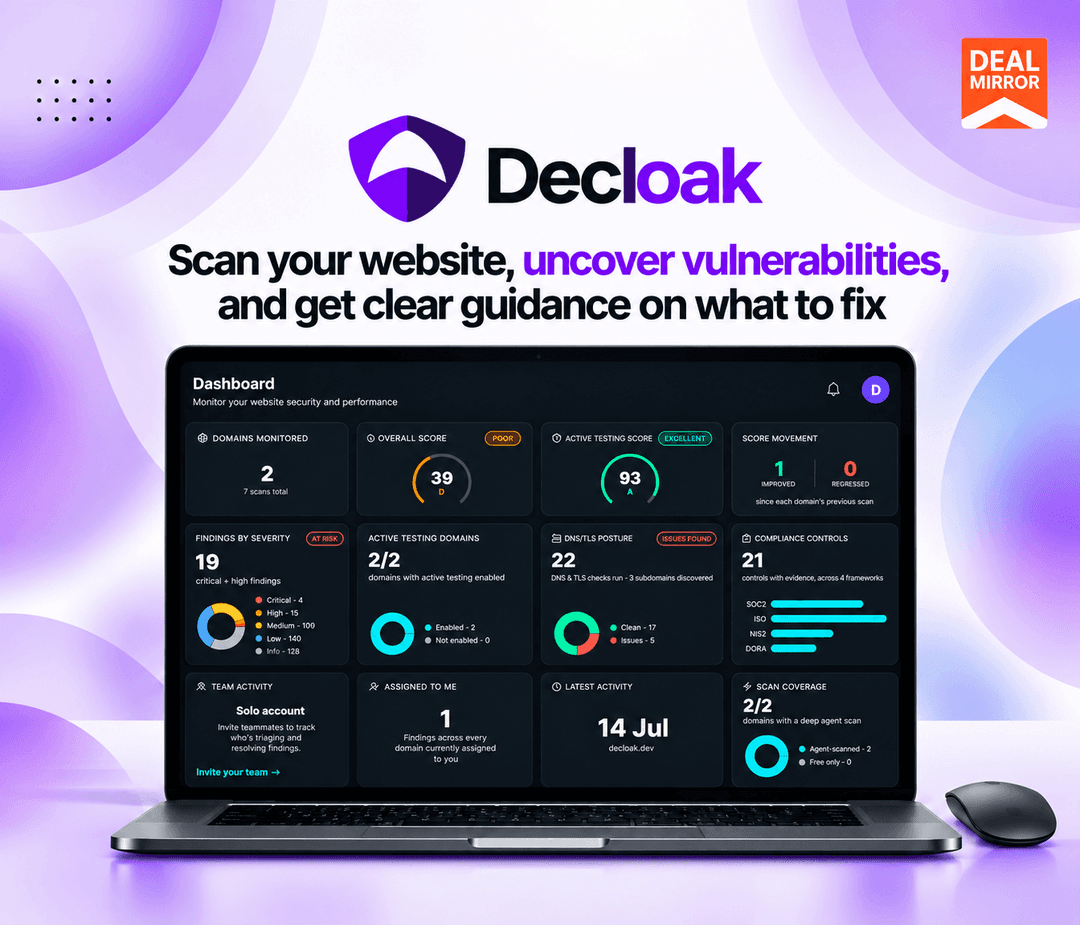
Decloak at a glance
- Platform
- Web, Lovable, Supabase, Base44, Bubble
- Note
- Lifetime access.
Which Decloak plan do you need?
Prices in USD, excluding tax.
| Tier 1 | Tier 2 | Tier 3 | |
|---|---|---|---|
| One-time price | $49 | $158 | $198 |
| Regular price (DealMirror) | |||
| You save | $425 | $1,134 | $1,422 |
| Includes | Full AI agent investigation; Up to 50 pages per scan; Per-finding remediation guidance; Priority Remediation Plan (top fixes, AI-written, exportable PDF); AI assistant chat; DNS & SSL/TLS security analysis; Subdomain takeover detection; Open port & service discovery for IP scans; PDF evidence export; Scheduled recurring scans; Scan comparison reports; Email alerts for new criticals | Full AI agent investigation; Up to 200 pages per scan; Per-finding remediation guidance; Priority Remediation Plan (top fixes, AI-written, exportable PDF); AI assistant chat; DNS & SSL/TLS security analysis; Subdomain takeover detection; Open port & service discovery for IP scans; PDF evidence export; Scheduled recurring scans; Scan comparison reports; Email alerts for new criticals; ISO 27001 / SOC2 / NIS2 / DORA / LGPD / PCI DSS / NIST CSF / EU CRA control mapping; Remediation tracking; Team access and finding assignment; Slack and webhook notifications; API access; Audit evidence packages; Audit activity log | Full AI agent investigation; Up to 200 pages per scan; Per-finding remediation guidance; Priority Remediation Plan (top fixes, AI-written, exportable PDF); AI assistant chat; DNS & SSL/TLS security analysis; Subdomain takeover detection; Open port & service discovery for IP scans; PDF evidence export; Scheduled recurring scans; Scan comparison reports; Email alerts for new criticals; ISO 27001 / SOC2 / NIS2 / DORA / LGPD / PCI DSS / NIST CSF / EU CRA control mapping; Remediation tracking; Team access and finding assignment; Slack and webhook notifications; API access; Audit evidence packages; Audit activity log; Active Security Testing (DAST); Independent Active Testing Score; AI Pentesting (exploitation-confirmation testing); Forced browsing, CORS, reflected-input probes; API endpoint discovery & testing (REST, GraphQL, SOAP); Authenticated scan mode (session capture); Enable active testing via API / MCP; Expert Mode & Scan Profiles (rate limits, crawl scope, per-tool pentest control) |
Before you buy: DealMirror's terms and extra costs
- Note. Lifetime access.
- Redeem. Redeem within 60 days of purchase.
- Refund. 30-day money-back guarantee for non-Prime members and regular users.
- Refund. 60-day money-back guarantee for DealMirror Prime members only.
What is Decloak?
Decloak scans websites for security risks across HTTP/TLS, page content, JavaScript, network activity, third-party services, and platform configurations. It provides findings, a security score, a letter grade, an AI-generated summary, deeper investigations, remediation guidance, recurring scans, and compliance evidence.
What Decloak says it does
- Eight-layer website security scanning analyzes HTTP/TLS, HTML, JavaScript, network traffic, third-party services, and platform configurations. (Decloak's figure)
- Security posture is measured with a weighted score from 0–100 and a grade from A to F. (Decloak's figure)
- Scanning a URL in seconds produces security findings, an overall score, a letter grade, and an AI-generated summary.
- JavaScript vulnerability detection identifies vulnerable libraries, affected versions, and relevant CVE details.
- Third-party script monitoring discovers external domains and scripts loaded by a website.
- AI-generated remediation plans provide prioritized, plain-language recommendations.
- Scan comparison reports track newly detected issues, resolved vulnerabilities, and changes in severity.
- Authorized active testing can investigate potential vulnerabilities and collect evidence of confirmed findings.
- Compliance reporting provides framework mappings and security evidence for reviews and audits.
- API access connects scans and results to development workflows and MCP-compatible AI agents.
Why Decloak
Websites can hide outdated JavaScript libraries, missing security headers, exposed subdomains, risky third-party scripts, and incorrect configurations. Manual review takes time, and basic scanners may not explain what needs attention first. Decloak organizes findings and remediation guidance so teams can investigate risks, prioritize fixes, and verify changes.
How does Decloak work?
Enter a website URL
Paste the URL you want to check into the scanner.
Run the security scan
Supported layers examine HTTP/TLS, scripts, browser network activity, platforms, and other security signals.
Review the report
Review findings, the security score, letter grade, and AI-generated summary.
Investigate and prioritize
Examine additional pages and related findings, then get plain-language remediation guidance.
Fix and monitor
Remediate issues, rescan to compare results, and schedule recurring checks with alerts.
Then it handles:
- Scan website security configurations
- Detect vulnerable JavaScript libraries
- Review headers, cookies, CORS, and TLS
- Trace third-party scripts and domains
- Discover subdomains and takeover risks
- Prioritize security remediation
- Compare scans and track fixes
- Produce compliance evidence
Who is Decloak for?
Built for
- Website owners and administrators
- Web developers
- SaaS startups and AI-built application creators
- Security, compliance, and audit teams
- Digital agencies and consultants
Not for
- Users whose platforms or required analysis layers are unsupported
- Teams without authorization to run active security tests
What is included in Decloak?
Website scanning
- Eight-layer analysis Checks HTTP/TLS, HTML, JavaScript, network traffic, third parties, and platform settings.
- JavaScript vulnerabilities Finds vulnerable libraries, affected versions, and relevant CVE details.
- Headers and transport security Reviews headers, cookies, CORS, certificates, and TLS configurations.
- Third-party scripts Identifies external domains and scripts loaded by a website.
- DNS and subdomain discovery Examines DNS records, certificates, and subdomains for takeover and configuration risks.
- CMS and platform checks Checks supported platforms for known vulnerabilities, exposed databases, and risky configurations.
- Exposed services Checks supported applications for exposed databases, APIs, and service-role keys.
Reports and investigation
- Security reports Returns findings, score, letter grade, and an AI-generated summary in seconds.
- Security score and grade Uses a weighted 0–100 score and a grade from A to F.
- AI website investigation Investigates multiple pages and related findings for potential vulnerabilities.
- Remediation plans Creates prioritized, plain-language recommendations for common security issues.
- Source map exposure Checks source maps and configuration problems that may expose application code.
Monitoring and remediation
- Scheduled scans Runs recurring scans to check for security changes over time.
- Security alerts Sends email alerts about newly detected critical findings.
- Messaging and webhook notifications Supports Slack and webhook notifications for team workflows.
- Scan history Tracks new findings, resolved vulnerabilities, and changes in severity.
- Remediation tracking Organizes assigned findings and records remediation activity.
- PDF evidence export Exports findings as PDF evidence for team and client workflows.
Testing and integrations
- Active security testing Runs authorized tests to investigate potential vulnerabilities on supported targets.
- AI pentesting Collects supporting evidence for confirmed findings during authorized tests.
- API access Connects scans and results to development workflows through an API.
- MCP-compatible agents Connects scans and results to MCP-compatible AI agents.
Compliance and reporting
- Compliance reporting Generates framework mappings and security evidence for reviews and audits.
- Framework coverage Maps findings to ISO 27001, SOC 2, NIS2, DORA, and other frameworks.
- Audit evidence packages Organizes findings, mappings, and activity for audit preparation.
- Audit activity log Records scan and remediation activity for security review.
- White-label PDF branding Presents client reports under an agency or consultant brand.
Video review
We have not reviewed Decloak on video yet.
Get notifiedBuyer reviews
No reviews yet. Bought Decloak? Add it to your workspace and share what it replaced.
Add to your workspaceDecloak questions
What does Decloak do?
Decloak scans websites across eight layers, including HTTP/TLS, HTML, JavaScript, network traffic, third-party services, and platform configurations. It reports findings, a 0–100 security score, an A–F grade, and an AI-generated summary. It identifies vulnerable JavaScript libraries, weak headers, exposed subdomains, risky external scripts, and configuration issues, then provides prioritized remediation guidance.
Who is Decloak designed for?
Decloak is designed for website owners and administrators, web developers, SaaS startups, creators of AI-built applications, digital agencies and consultants, and security, compliance, audit, and penetration-testing teams. Active security testing is intended for authorized targets. Supported plans also offer team workflows, compliance evidence, integrations, and white-label PDF branding.
Can I scan a website before buying?
Yes. The free scanner accepts a website URL and can be used without an account. It runs supported analysis layers and provides a security report. Paid plans add deeper investigation across multiple pages, detailed remediation guidance, scheduled scans, comparisons, alerts, and other team or compliance features.
What are the differences between the three tiers?
Tier 1 ($49) includes full AI investigation, up to 50 pages per scan, remediation guidance and PDF export, scheduled scans, comparisons, email alerts, DNS/SSL-TLS analysis, and subdomain takeover detection. Tier 2 ($158) increases coverage to up to 200 pages and adds compliance mapping, remediation tracking, team assignment, Slack/webhooks, API access, and audit evidence/logs. Tier 3 ($198) adds Active Security Testing (DAST).
How do redemption and refunds work?
Redeem the deal within 60 days from purchase. Regular users and non-Prime members have a 30-day money-back guarantee, while DealMirror Prime members have a 60-day money-back guarantee. The purchased tier provides lifetime access.
Are there ongoing fees or extra charges?
The plans list purchase prices of $49 for Tier 1, $158 for Tier 2, and $198 for Tier 3, with lifetime access. No subscription renewal, usage overage, add-on, or other extra-charge policy is stated in the provided information, so additional costs cannot be confirmed.