

Marketing · Lifetime deal
HookLab
Capture, inspect and replay webhook requests to localhost, staging or production.
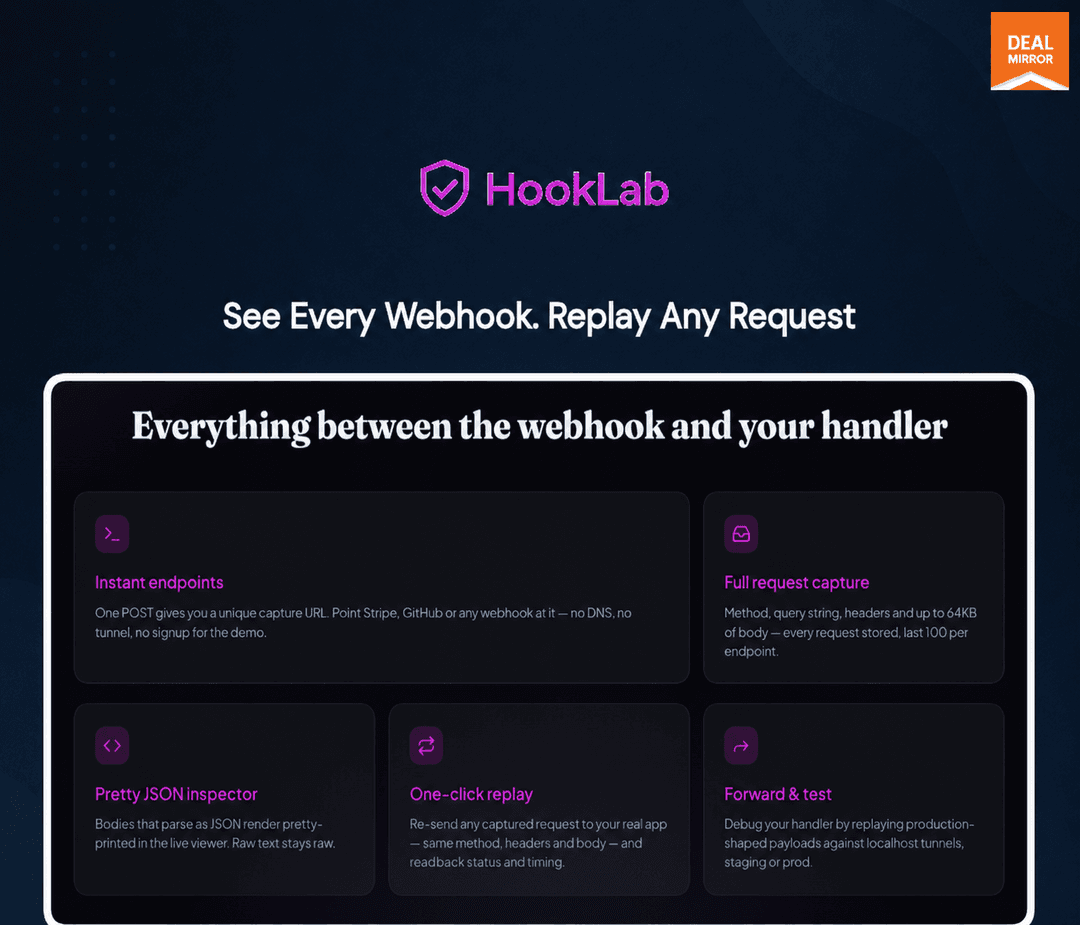
HookLab at a glance
- Platform
- Web
- Support
- Email support, including direct contact with the founder.
- Note
- Includes all current and future webhook-inspection features, per the listing.
Our take
Is HookLab worth buying?
Based on the DealMirror listing, HookLab is a single-tier webhook debugger with unlimited endpoints and requests. The listing describes it as the business tier. Several useful features, such as team workspaces and alerts, are roadmap only.
Good fit if
- You debug webhook integrations often.
- You want to replay a captured request against local code.
- You want unlimited endpoints without a monthly bill.
Skip it if
- You need shared team workspaces or alerts now.
- You rarely work with webhooks.
Which HookLab plan do you need?
Prices in USD, excluding tax.
| Lifetime deal | |
|---|---|
| One-time price | $39 |
| Regular price (DealMirror) | |
| You save | $240 |
| Endpoints | Unlimited |
| Captured requests | Unlimited |
| Custom domain | Included |
Before you buy: DealMirror's terms and extra costs
- Refund. 30-day money-back guarantee for regular users, or 60 days for DealMirror Prime members.
- Redeem. Redeem within 60 days of purchase.
- Support. Email support, including direct contact with the founder.
- Note. Includes all current and future webhook-inspection features, per the listing.
- Platform. Web dashboard. No tunnel is needed unless you replay to a local machine.
What is HookLab?
HookLab gives developers a live webhook endpoint, a payload inspector and one-click replay. You capture every request, inspect headers, query parameters and the raw body, then replay it to localhost, staging or production. It verifies Stripe and GitHub signatures and can simulate custom status codes and delays to test retries. The lifetime deal is a single tier with unlimited endpoints and requests.
What HookLab says it does
- Instant webhook endpoints with real-time request capture
- One-click replay to localhost, staging or production
- Stripe and GitHub signature verification
- Unlimited endpoints and unlimited captured requests
Why HookLab
It replaces guessing when a provider dashboard says delivered but your integration fails. It is a debugging tool, not a monitoring service: alerts, a CLI and shared team workspaces are listed as roadmap items, not current features.
How does HookLab work?
Redeem the code
Buy on DealMirror and redeem within 60 days.
Create an endpoint
Generate a unique webhook URL and point a provider at it.
Inspect requests
View method, headers, query and the raw body as they arrive.
Replay
Send the same request to localhost, staging or production.
Then it handles:
- Capturing webhook requests
- Inspecting raw payloads
- Replaying requests
- Verifying Stripe and GitHub signatures
- Simulating status codes and delays
- Custom domain endpoints
Who is HookLab for?
Built for
- Developers building webhook integrations
- QA teams reproducing failed deliveries
- Agencies that want white-label endpoints
Not for
- Teams that need shared workspaces today, which are on the roadmap only
- Anyone who needs monitoring alerts or a CLI now
What is included in HookLab?
Capture and inspect
- Instant endpoints
- Raw and JSON payload view
- Sensitive header removal Authorization, cookies, API keys
Replay and test
- One-click replay
- Signature verification Stripe and GitHub
- Response simulation status codes and delays
Branding
- Custom domain
- White-label endpoints
Video review
We have not reviewed HookLab on video yet.
Get notifiedBuyer reviews
No reviews yet. Bought HookLab? Add it to your workspace and share what it replaced.
Add to your workspaceHookLab questions
What is HookLab?
A web tool that captures webhook requests, shows the raw payload and replays them to your local, staging or production server.
Who is it for?
Developers and QA teams who debug webhook integrations.
What are the limits?
The single tier lists unlimited endpoints and unlimited captured requests, with a custom domain and white-label endpoints.
Which signatures can it verify?
Stripe and GitHub today. Slack, Shopify and Twilio verification are listed as coming soon.
Does it store my secrets?
The listing says sensitive headers such as Authorization, cookies and API keys are removed before storage.
What is the refund policy?
30 days for regular users and 60 days for Prime members. Redeem within 60 days.
Often compared with
These are other tools in the same space, not deals on GrabLTD.
- Webhook.site
- RequestBin
- Hookdeck
- ngrok
- Svix
Sources
Checked . Prices and terms on this page come from: