

Design · Lifetime deal
KDPage
Puzzles, covers and print-ready interiors for KDP and Etsy in one browser workspace.
KDPage at a glance
- Platform
- Web
- Upgrades
- Codes are not stackable.
- Support
- Free support. Pro lists priority support.
Our take
Is KDPage worth buying?
Based on the DealFuel listing, KDPage is a KDP focused publishing suite where AI runs on your own API key. Our tier maps to the Pro Studio plan, with set limits on accounts, credits and batches. The 30 day redemption window is short.
Good fit if
- You publish puzzle or low-content books on KDP.
- You sell printable products on Etsy.
- You are fine supplying your own AI API key.
Skip it if
- You need AI included without an API key.
- You need Agency level limits on the entry plan.
- You may not redeem within 30 days.
Which KDPage plan do you need?
Prices in USD, excluding tax.
| Pro Studio Lifetime | Agency Lifetime | |
|---|---|---|
| One-time price | $69 | $98 |
| Accounts | 1 | Not stated |
| Vector line art credits | 100 per month | Not stated |
| Brand and pen-name profiles | Up to 10 | Not stated |
| Bulk batch studio | 15 books per batch | Not stated |
| Support | Priority | Not stated |
Before you buy: DealFuel's terms and extra costs
- Refund. 30 day refund, per the DealFuel listing.
- Redeem. Redeem the coupon code within 30 days. One code per user or account.
- Upgrades. Codes are not stackable.
- AI usage cost. AI features use your own OpenAI, Gemini or Stability API key; those providers bill you separately.
- Support. Free support. Pro lists priority support.
- Platform. Browser based on desktop, mobile and tablet.
What is KDPage?
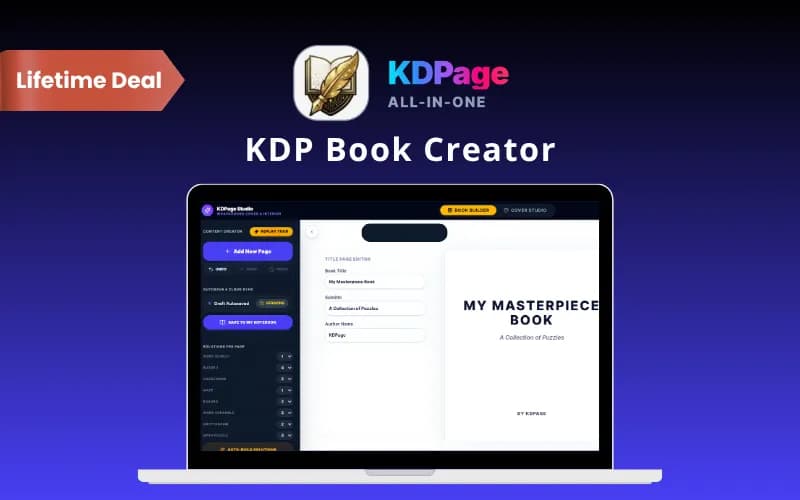
KDPage is a browser-based publishing suite for KDP authors, puzzle publishers and Etsy creators. It generates puzzles with solution pages, designs covers with automatic spine, bleed and safe zones, and exports 300 DPI print-ready PDFs. AI features use your own API key. The deal is sold through DealFuel as two lifetime plans, Pro Studio and Agency.
What KDPage says it does
- 300 DPI print-ready PDFs sized for KDP trim, bleed and gutter
- Puzzle generators with automatic solution pages
- Full commercial rights and watermark-free exports
- Publishing workflows for KDP, Etsy and IngramSpark
Why KDPage
It replaces separate puzzle, cover and dimension tools with one workspace. AI features run on your own API key, so provider costs are separate, and per-book and per-batch limits depend on the plan.
How does KDPage work?
Redeem the code
Redeem the DealFuel coupon code within 30 days of purchase.
Pick a book type
Choose a puzzle book, activity book, journal or other low-content format.
Generate the interior
Create puzzles and solution pages, or import data by CSV.
Design the cover
Set trim size and let spine and bleed be calculated.
Export
Export print-ready PDF or EPUB files for upload.
Then it handles:
- Puzzle generation
- Cover design with spine and bleed
- KDP interior formatting
- Batch book exports
- Etsy digital products
- AI drafting with your own key
Who is KDPage for?
Built for
- KDP authors and low-content book publishers
- Puzzle book creators
- Etsy sellers of printable products
Not for
- Buyers who want AI included without their own API key
- Authors writing long prose manuscripts only
- Anyone who cannot redeem within 30 days
What is included in KDPage?
Puzzles and interiors
- Puzzle generators sudoku, mazes, crosswords, word search
- Solution pages generated automatically
- CSV import and batch export
Covers and export
- Cover studio automatic spine and bleed
- 300 DPI PDF export
- EPUB export
- SVG and source files
AI and rights
- Bring your own API key AI OpenAI, Gemini, Stability
- Commercial rights
- Watermark-free exports
Video review
We have not reviewed KDPage on video yet.
Get notifiedBuyer reviews
No reviews yet. Bought KDPage? Add it to your workspace and share what it replaced.
Add to your workspaceKDPage questions
What is KDPage?
A browser-based publishing suite for KDP, with puzzle generators, a cover studio and print-ready exports.
Is AI included?
AI uses your own API key (OpenAI, Gemini or Stability), so you pay those providers separately.
Do I get commercial rights?
The listing says both plans include full commercial rights and watermark-free exports.
How do the plans differ?
Pro Studio has 1 account and 100 vector credits a month. Agency has 3 accounts, 300 credits and higher per-book limits.
What is the refund policy?
30 days. Redeem the code within 30 days. Codes are not stackable, one per account.
Which platforms can I publish to?
The listing names KDP, Etsy and IngramSpark.
Often compared with
These are other tools in the same space, not deals on GrabLTD.
- Canva
- Book Bolt
- Publisher Rocket
- Amazing Selling Machine
- Vellum
Sources
Checked . Prices and terms on this page come from: