

Productivity · Lifetime deal
Upwip
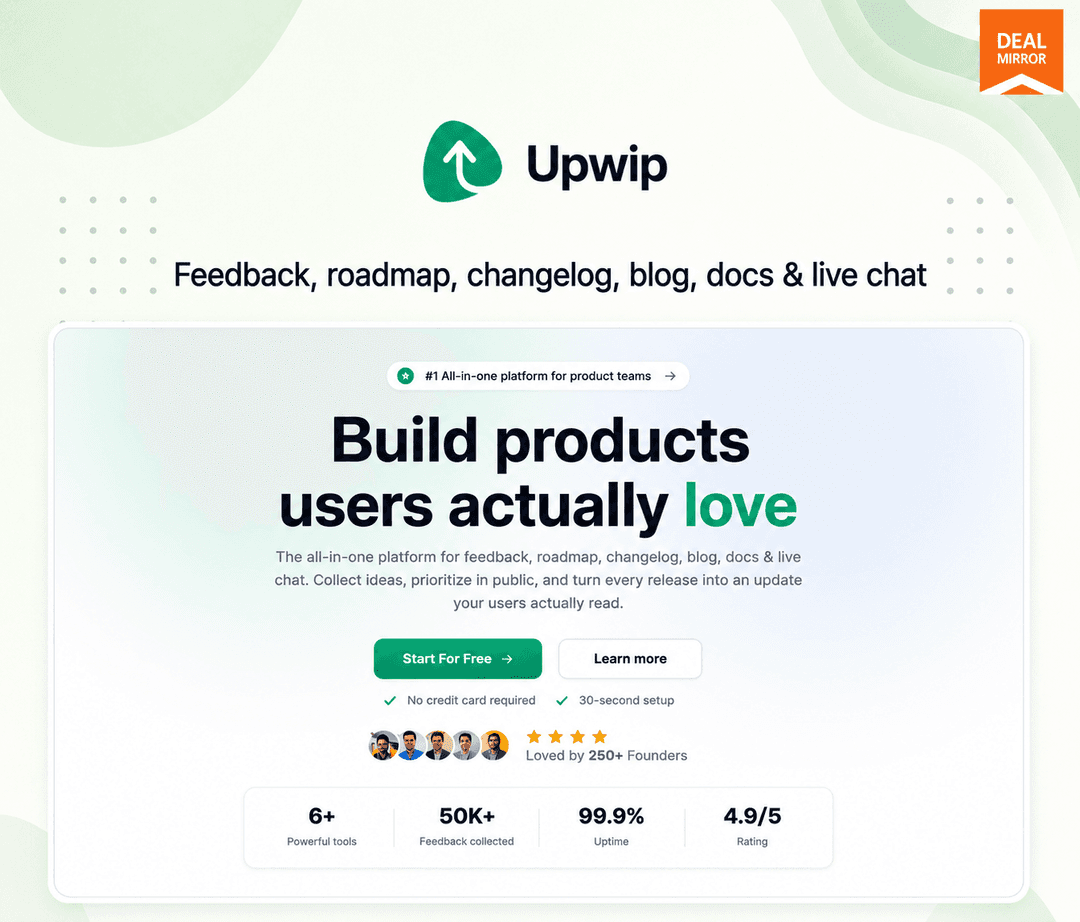
Feedback board with voting, a public roadmap and changelog, plus docs, blog and status page.
Upwip at a glance
- Platform
- Web
- Support
- Email support, per the listing.
Our take
Is Upwip worth buying?
Based on the DealMirror listing, the Tier 1 plan is a lifetime feedback board with roadmap, changelog and extras for one workspace. It suits a single product team. Multi-product teams should look at the larger tier on the page.
Good fit if
- You run one product and want a public feedback board.
- You want a roadmap and changelog on your own domain.
- You want unlimited users without per-seat fees.
Skip it if
- You manage several products and need more than 1 workspace.
- You need a documented support SLA.
Which Upwip plan do you need?
Prices in USD, excluding tax.
| Tier 1 | Tier 2 | |
|---|---|---|
| One-time price | $79 | $199 |
| Regular price (DealMirror) | ||
| You save | $29 | $149 |
| Workspaces | 1 | Not stated |
| Users and team members | Unlimited | Not stated |
| Posts | Unlimited | Not stated |
Before you buy: DealMirror's terms and extra costs
- Refund. 30-day money-back guarantee for regular buyers, 60 days for DealMirror Prime members.
- Redeem. Redeem within 60 days of purchase.
- Support. Email support, per the listing.
- Platform. Web based. The chat widget installs with a code snippet.
What is Upwip?
Upwip gathers customer feedback in one place. Users post and vote on feature requests, bug reports and ideas on a board, and you publish a roadmap and changelog to show what is planned and shipped. A blog, documentation, status page and live chat widget are included, with a custom domain. The Tier 1 lifetime plan covers 1 workspace.
What Upwip says it does
- Feedback board, roadmap and changelog in one tool
- Unlimited posts, users and team members
- Custom domain, branding removal and advanced analytics
- Blog, documentation, status page and chat widget
Why Upwip
Feedback is spread across tickets, chat and email. Upwip puts it on a ranked board and ties it to a public roadmap. Each tier is limited by workspaces, so agencies or multi-product teams need to check the count.
How does Upwip work?
Redeem the code
Buy on DealMirror and redeem within 60 days.
Set up a workspace
Create your board and add your branding.
Collect feedback
Let users post and vote on requests.
Publish updates
Share the roadmap and changelog as items ship.
Then it handles:
- Collecting feature requests and bug reports
- Ranking requests by votes
- Publishing a public roadmap
- Posting changelog entries
- Hosting a blog and documentation
- Showing a status page
- Embedding a live chat widget
Who is Upwip for?
Built for
- SaaS founders and product teams collecting user feedback
- Teams that want a public roadmap on a custom domain
- Support teams that want feedback tied to updates
Not for
- Buyers who need more than 1 workspace on Tier 1
- Teams that want a documented support SLA
- Anyone who cannot redeem within 60 days
What is included in Upwip?
Feedback and roadmap
- Feedback board
- Roadmap
- Changelog
Customer-facing extras
- Blog and documentation
- Status page
- Live chat widget
Setup
- Custom domain and custom code
- Branding removal
- Advanced analytics
- All integrations
Video review
We have not reviewed Upwip on video yet.
Get notifiedBuyer reviews
No reviews yet. Bought Upwip? Add it to your workspace and share what it replaced.
Add to your workspaceUpwip questions
What is Upwip?
A customer feedback tool with a voting board, public roadmap and changelog, plus a blog, docs, status page and chat widget.
Are there per-user charges?
The listing says no. Posts, users and team members are unlimited on both tiers.
How do the tiers differ?
Tier 1 lists 1 workspace and Tier 2 lists 5. Features are the same in both.
Can I use my own domain?
Yes. A custom domain and custom code are listed.
What is the refund policy?
DealMirror lists 30 days for regular buyers and 60 days for Prime members. Redeem within 60 days.
Often compared with
These are other tools in the same space, not deals on GrabLTD.
- Canny
- Productboard
- Featurebase
- Nolt
- UserVoice
Sources
Checked . Prices and terms on this page come from: