

AI Tools · Lifetime deal
Vexp
Local dependency-graph context for AI coding agents with token budgets and an MCP server.
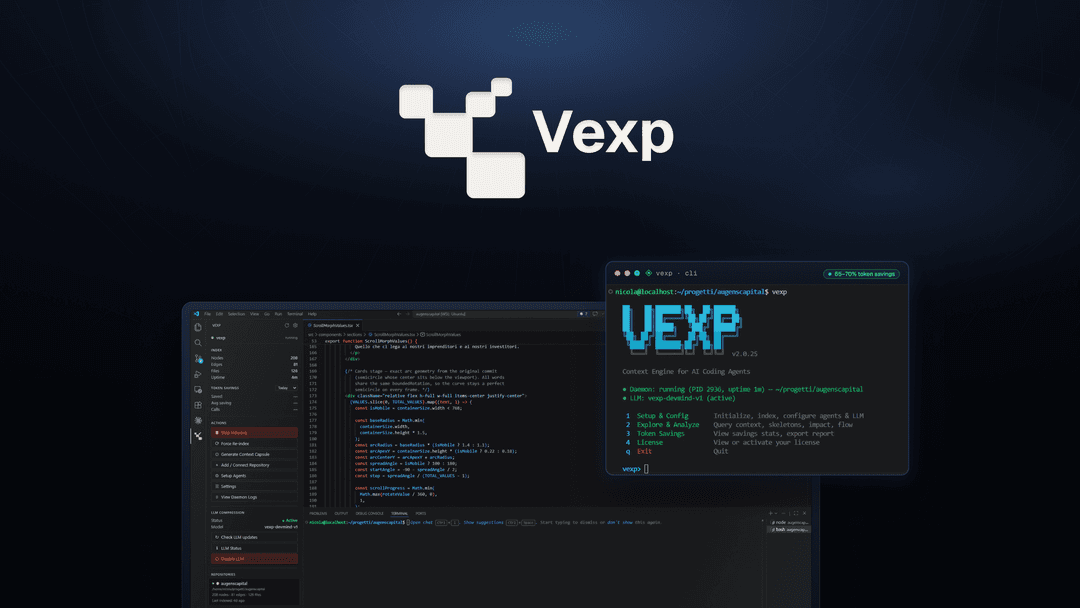
Vexp at a glance
- Platform
- VS Code, CLI, Windows, Mac, Linux
- Upgrades
- Upgrades while the deal is live. Downgrades only within 60 days of purchase.
- Support
- Vendor expects to respond within 24 hours. Docs at vexp.dev.
- Note
- Licenses are per device. Nodes are functions, classes or types.
Our take
Is Vexp worth buying?
Based on the AppSumo listing, Tier 1 is a lifetime local context engine for one seat and one repo per workspace. It suits a solo developer on a single machine. The page gives inconsistent tool and language counts, so check the docs for your stack.
Good fit if
- You use AI coding agents and want leaner context.
- You work on one machine and one main repo.
- You prefer local indexing over a hosted service.
Skip it if
- You work across several machines on one license.
- You need support for languages the page does not list.
Which Vexp plan do you need?
Prices in USD, excluding tax.
| Tier 1 | Tier 2 | Tier 3 | Tier 4 | |
|---|---|---|---|---|
| One-time price | $49 | $119 | $199 | $399 |
| Regular price (AppSumo) | Not stated | Not stated | Not stated | |
| You save | $51 | |||
| Nodes | 10,000 | Not stated | Not stated | Not stated |
| Seats | 1 | Not stated | Not stated | Not stated |
| Repos per workspace | 1 | Not stated | Not stated | Not stated |
| Projects | Unlimited | Not stated | Not stated | Not stated |
Before you buy: AppSumo's terms and extra costs
- Refund. Refundable within 60 days through AppSumo, per the listing.
- Redeem. Activate within 60 days of purchase.
- Upgrades. Upgrades while the deal is live. Downgrades only within 60 days of purchase.
- Support. Vendor expects to respond within 24 hours. Docs at vexp.dev.
- Platform. Linux, macOS 11+ and Windows 10+. VS Code extension or CLI.
- Note. Licenses are per device. Nodes are functions, classes or types.
What is Vexp?
Vexp is a local context engine for AI coding agents. It parses your repository into a dependency graph on your machine and gives the agent only the files and symbols a task depends on, sized to a token budget you set. It runs as a VS Code extension or CLI and connects to agents through an MCP server. Tier 1 covers 1 seat, 1 repo per workspace and 10,000 nodes.
What Vexp says it does
- Indexes locally with tree-sitter, with no network calls for indexing (Vexp's figure)
- Context sent to the agent is limited to a token budget you set
- Works with Claude Code, Codex, Cursor, Windsurf, Zed and other MCP agents
- Optional on-device model claims about 30% extra token savings (Vexp's figure)
Why Vexp
Agents either retrieve too much context and cost more, or too little and miss dependencies. Vexp builds a local dependency graph to send tighter context. Licenses are per device, and the page gives some inconsistent counts for tools and languages.
How does Vexp work?
Activate the license
Buy on AppSumo and activate within 60 days.
Install
Add the VS Code extension or CLI.
Index your repo
Vexp builds a local dependency graph, stored in a local file.
Connect your agent
Point your agent at the MCP server and set a token budget.
Then it handles:
- Indexing a repo into a dependency graph
- Returning only relevant files and symbols
- Setting a token budget
- Tracing call chains and imports
- Filtering secrets from context
- Session memory
- Multi-repo workspaces
Who is Vexp for?
Built for
- Developers using AI coding agents on large repos
- Teams that want to cut token usage
- People who want local, offline indexing
Not for
- Anyone needing two machines on Tier 1, since licenses are per device
- Salesforce Apex projects, which are not supported
- Anyone who wants hosted indexing
What is included in Vexp?
Context engine
- Local dependency graph tree-sitter, 30+ languages per page
- Token-budgeted context
- Call chain and import tracing
Agent setup
- MCP server 11 or 12 tools per page
- VS Code extension and CLI
- Works offline
- Secrets filtered by default
Video review
We have not reviewed Vexp on video yet.
Get notifiedBuyer reviews
No reviews yet. Bought Vexp? Add it to your workspace and share what it replaced.
Add to your workspaceVexp questions
What is Vexp?
A local context engine that builds a dependency graph of your repo and sends AI coding agents only the code they need.
What are the Tier 1 limits?
10,000 nodes, 1 seat and 1 repo per workspace. Projects are unlimited.
Is a license per machine?
Yes. Using two machines needs two seats, which the listing places on Tier 3.
Which agents work?
Claude Code, Codex, Cursor, Windsurf, Zed and other agents through an MCP server.
What is the refund policy?
Refundable within 60 days through AppSumo. Activate within 60 days.
Often compared with
These are other tools in the same space, not deals on GrabLTD.
- Sourcegraph Cody
- Continue
- Aider
- Greptile
- Repomix
Sources
Checked . Prices and terms on this page come from: